

EPA vs DHA in Fish Oil: What to Actually Read on the Label
Research review

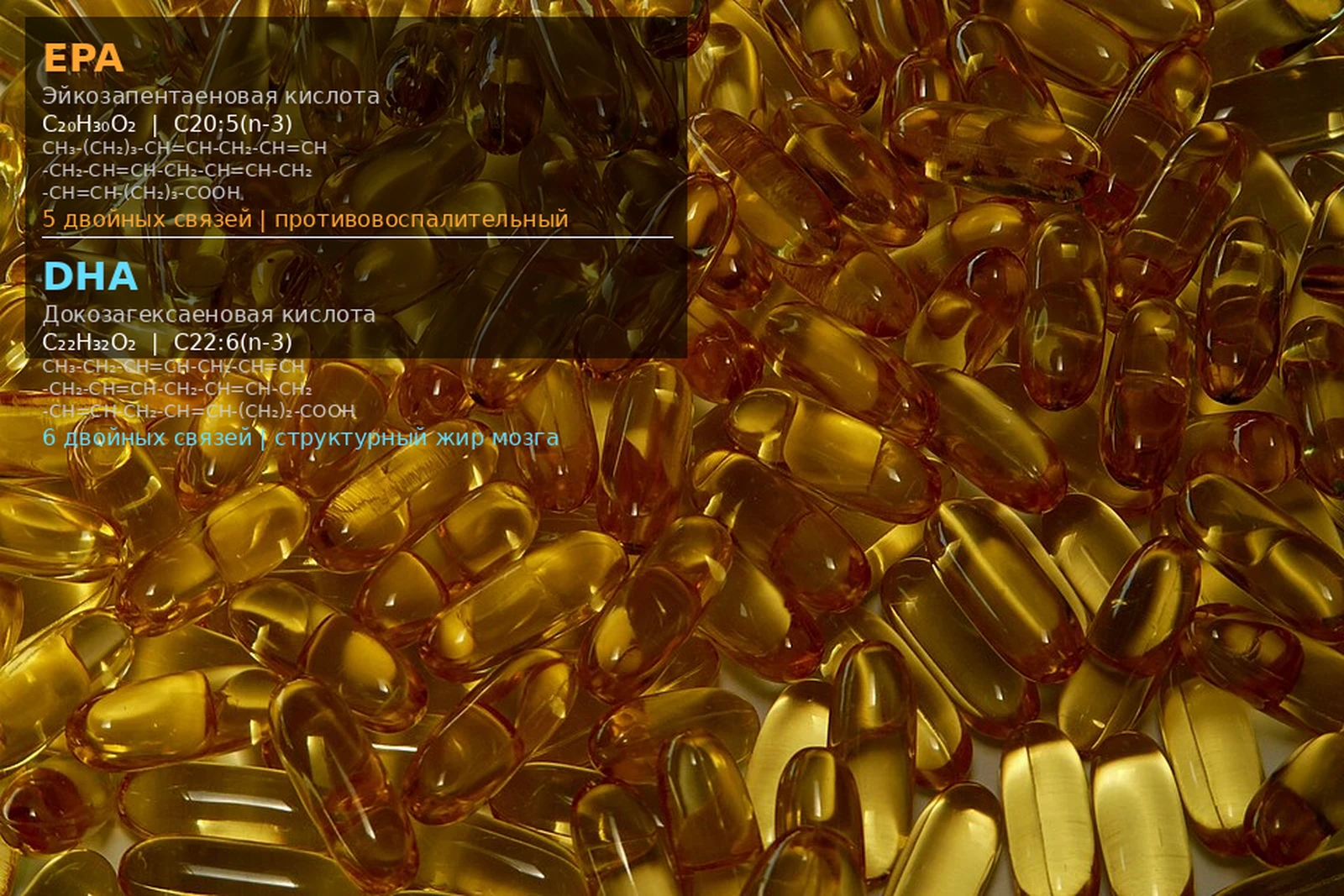
Photo: Oddman47, "Fish Oil Capsules", CC0, Wikimedia Commons. An illustration of the topic, not a photo of a specific product.
The hook
"1000 mg" on a fish oil bottle does not mean 1000 mg of omega-3. That is the weight of the whole capsule, including other fats. The numbers that matter are smaller and lower on the panel: how much EPA and how much DHA each capsule contains. That pair, not the big number on the front, is what the research is about.
In brief
- Fish oil contains two different long-chain omega-3 fats: EPA and DHA. Read the separate EPA and DHA lines, not the total capsule weight [background].
- A meta-analysis of 15 randomised trials (916 participants) found an antidepressant effect only in products where EPA made up at least 60% of EPA+DHA [checked, S-001].
- A later meta-analysis (26 studies, 2,160 participants) found benefit in EPA-dominant products at EPA doses up to 1 g a day, and no benefit in DHA-dominant products [checked, S-003].
- The data do not give an "optimal dose": the ranges in the two meta-analyses differ [editorial opinion based on S-001 and S-003].
- The European Food Safety Authority (EFSA) describes 250 mg of EPA+DHA a day as an adequate intake, and considers up to 5 g a day from supplements not a safety concern for adults [checked, S-002].
What EPA and DHA are
EPA (eicosapentaenoic acid) and DHA (docosahexaenoic acid) are the two main long-chain omega-3 fatty acids found in fish oil and oily fish. They are different molecules and behave differently in studies, so they should not be added together as one "omega".
What the label says and what it means
Here is an example (hypothetical, not data from a real product): the front says "1000 mg fish oil per capsule", and the supplement facts show "EPA 180 mg, DHA 120 mg". That means the capsule contains 300 mg of active omega-3, and the rest is other fat. So compare products by their EPA and DHA lines, calculated per serving [example, arithmetic].
Other things to check. These are our editorial pointers, not research findings:
- Separate EPA and DHA lines. If the label only says "omega-3", you cannot compare products [opinion].
- Serving size. How many capsules make up the serving the numbers are based on.
- Form. Labels often say "triglyceride" or "ethyl ester". Ask the manufacturer which form the EPA and DHA are in.
- Independent purity testing. Look for third-party certificates (for example IFOS, NSF, GOED) and ask whether each batch is tested.
What the research says about the EPA:DHA ratio
Keep three things apart: what studies found, what regulators allow, and what blogs recommend.
Depressive disorders (research, not advice). Sublette and colleagues (2011) pooled 15 randomised placebo-controlled trials with 916 participants. Products where EPA made up at least 60% of EPA+DHA showed a clear effect on depression scales (effect size 0.532); products with less than 60% EPA showed no effect. The researchers looked at 200–2,200 mg of EPA per day above DHA [S-001, meta-analysis]. Liao and colleagues (2019) included 26 studies and 2,160 participants. They found benefit in EPA-dominant products at EPA doses up to 1 g a day, and none in DHA-dominant products [S-003, meta-analysis].
What this means, and what it does not:
- These are data from trial participants with a diagnosed depression. It is not advice to "take it when you feel down". Fish oil does not treat depression and does not replace prescribed treatment. Do not stop or change therapy without your doctor.
- Both analyses pool different trials with different doses and formulas. A single "optimal dose" does not follow from them: one analysis covers a working range up to 2,200 mg of EPA, the other found benefit at doses up to 1 g [editorial opinion].
Heart and blood vessels (regulator's position). In 2012 EFSA concluded that the claimed effects on blood pressure and triglycerides require 2–4 g of EPA+DHA a day, and that 250 mg a day is adequate for normal heart function [S-002]. This is an assessment of label health claims, not a recommendation to take specific doses. Discuss higher doses with your doctor.
Brain, eyes, pregnancy, children. Appropriate EPA:DHA ratios and doses depend on the individual's situation. If you are pregnant, breastfeeding, or choosing a supplement for a child, the composition and dose should be decided with a doctor.
Personal experience and practice
Author's personal experience | Serge Luboff, practising biohacker
The next section is personal experience and personal practice, not research findings. It is not an instruction or a recommendation.
I have been taking fish oil for several years and have built working guidelines for myself. I share them as a practitioner, not as a researcher. [personal experience]
Ratios I use personally:
- For general support and the cardiovascular system I take products with an EPA:DHA ratio of roughly 2:1 or 3:1. [from practice]
- During periods of high nervous-system load and mood work I prefer EPA-dominant formulas (EPA ≥60%), which matches what the meta-analyses found (S-001, S-003). [personal experience, consistent with research]
- During intense cognitive work I add formulas with more DHA, roughly 1:1 or 1:2 (EPA:DHA). [working hypothesis]
My doses in practice:
I usually take 1,000–2,000 mg of EPA+DHA a day, choosing products with EPA ≥60% during periods when I track my mood and stress resilience. During heavy training I have gone up to 3–4 g: I feel better subjectively, but this is my personal experiment, not a number from research. [personal experience]
The brain and DHA:
From my own observations and what I have read in popular neuroscience, DHA is a main structural fat of the brain and retina. That is why I do not drop DHA entirely in favour of EPA even when I am looking for an antidepressant effect. [working hypothesis]
Serotonin and dopamine:
In the biohacker community, omega-3s, especially EPA, are linked to supporting serotonin and dopamine pathways. I notice a difference subjectively. [personal experience, T4]
What is known, what is not, and the risks
Known:
- EPA and DHA are different acids, and in depression trials an EPA share of 60% or more is linked to an effect [S-001, S-003].
- EFSA considers supplements up to 5 g of EPA+DHA a day not a safety concern for adults (a 2012 assessment) [S-002].
Not known:
- The dose and ratio that are best for a particular person: the ranges in different meta-analyses do not match.
- Whether the forms (triglyceride vs ethyl ester) make a real difference in effect.
- How EPA:DHA ratios work for heart, brain and eyes: the data reviewed here do not give a definitive answer.
Risks and when to see a doctor:
- Check with a doctor before taking supplements, especially at high doses, with chronic illness, during pregnancy or breastfeeding, and for children.
- If you take medication, check the supplement with your doctor.
- If you have depression or anxiety, a supplement does not replace treatment.
- This article does not give individual doses or dosing schedules.
What to do next
How to choose a bottle using its label:
- Find the EPA and DHA lines in mg per serving and add them up. That is your active omega-3 per serving.
- Compare bottles by those lines, not by "1000 mg per capsule".
- Count the servings in the pack and divide the price by the total EPA+DHA. That is the real cost.
Questions to ask your doctor before starting: whether the supplement suits your health, medications and pregnancy status, what dose makes sense for you, and whether you need blood tests.
Our Nutraceuticals section on biohacking.biz collects guides like this on supplements. biohacking.biz the magazine and the shop belong to the same project: that is the disclosure.
Omega-3 without fish: for vegetarians and vegans
Fish oil is not the only source of EPA and DHA. Fish get their omega-3 from the microalgae that produce these acids. So the logical alternative is algae oil.
Plant sources of ALA (the precursor of EPA and DHA):
- Flaxseed oil and flaxseeds
- Chia seeds
- Walnuts
ALA converts into EPA and DHA in the body only in small amounts, so flaxseed oil does not replace the ready-made long-chain omega-3s.
Direct vegetarian source of EPA and DHA:
- Algae oil contains ready-made EPA and DHA, with no fish involved. It is available as vegan capsules. This is where the fish get their omega-3 in the first place.
This lets vegetarians and vegans get long-chain omega-3 directly, without the intermediate step.
Question for you
Which line on the fish oil bottle confused you most: the form, the certificates, the EPA and DHA amounts, or the price per serving? Tell us in the comments and we will cover it in the next piece.
What was verified and what was meant
| Claim | Status | Source |
|---|---|---|
| EPA and DHA are two different omega-3 acids in fish oil | background | — |
| Capsule weight is not the amount of EPA+DHA in it | example and arithmetic | — |
| "Triglyceride" and "ethyl ester" forms are often listed on labels | background | — |
| IFOS, NSF, GOED are examples of independent purity programmes | background | — |
| In a meta-analysis of 15 RCTs (916 participants), depression benefit appeared with EPA ≥60% and not with EPA below 60% | checked against abstract, meta-analysis | S-001 |
| Range of 200–2,200 mg EPA above DHA per day in S-001 | checked against abstract | S-001 |
| In a meta-analysis of 26 studies (2,160 participants), benefit with EPA ≥60% at doses up to 1 g a day, no benefit found for DHA-dominant products | checked against abstract, meta-analysis | S-003 |
| The data do not give a single "optimal dose" | editorial opinion | S-001, S-003 |
| EFSA: 250 mg EPA+DHA a day is an adequate intake and sufficient for normal heart function | checked against EFSA press release | S-002 |
| EFSA: the claimed effects on blood pressure and triglycerides require 2–4 g a day; not a dose recommendation | checked against EFSA press release | S-002 |
| EFSA: up to 5 g a day of supplements is not a safety concern for adults | checked against EFSA press release | S-002 |
| Author's personal experience: EPA:DHA ratios, doses, observations on mood and the brain | personal experience and practice, labelled in the block | — |
Based on the abstracts of the meta-analyses (S-001, S-003) and the EFSA press release (S-002). The full meta-analysis texts and EFSA's original 2012 opinion were not reviewed for this article.
Author: Serge Luboff, practising biohacker, yoga teacher, higher attestation from a university of natural sciences.
This article is not medical advice and does not replace a consultation with a doctor.
What was verified and what was meant
| Claim | Status | Source |
|---|---|---|
| EPA and DHA are two different omega-3 acids in fish oil | background | — |
| Capsule weight is not the amount of EPA+DHA in it | example and arithmetic | — |
| "Triglyceride" and "ethyl ester" forms are often listed on labels | background | — |
| IFOS, NSF, GOED are examples of independent purity programmes | background | — |
| In a meta-analysis of 15 RCTs (916 participants), depression benefit appeared with EPA ≥60% and not with EPA below 60% | checked against abstract, meta-analysis | S-001 |
| Range of 200–2,200 mg EPA above DHA per day in S-001 | checked against abstract | S-001 |
| In a meta-analysis of 26 studies (2,160 participants), benefit with EPA ≥60% at doses up to 1 g a day, no benefit found for DHA-dominant products | checked against abstract, meta-analysis | S-003 |
| The data do not give a single "optimal dose" | editorial opinion | S-001, S-003 |
| EFSA: 250 mg EPA+DHA a day is an adequate intake and sufficient for normal heart function | checked against EFSA press release | S-002 |
| EFSA: the claimed effects on blood pressure and triglycerides require 2–4 g a day; not a dose recommendation | checked against EFSA press release | S-002 |
| EFSA: up to 5 g a day of supplements is not a safety concern for adults | checked against EFSA press release | S-002 |
| Author's personal experience: EPA:DHA ratios, doses, observations on mood and the brain | personal experience and practice, labelled in the block | — |
Sources
| Source | Tier | Evidence | Accessed |
|---|---|---|---|
| Sublette et al., 2011, мета-анализ EPA в клинических исследованиях депрессии (J Clin Psychiatry 72(12)) | T1 | мета-анализ | October 27, 2026 |
| EFSA, пресс-релиз «EFSA assesses safety of long-chain omega-3 fatty acids», 27.07.2012 | T1 | мнение | October 27, 2026 |
| Liao et al., 2019, Efficacy of omega-3 PUFAs in depression: a meta-analysis (Transl Psychiatry, DOI 10.1038/s41398-019-0515-5) | T1 | мета-анализ | October 27, 2026 |
Vegetarian check: Fish oil is not vegetarian. Alternative: algae oil, which contains EPA and DHA directly.
Serge Luboff, Practising biohacker
Serge Luboff, practising biohacker, yoga teacher, higher attestation from a university of natural sciences.
This article is not medical advice and does not replace a consultation with a doctor.